Digital marketing is changing fast, thanks to artificial intelligence. The 2024 State of Marketing AI Report shows a big shift. Marketing pros are quickly using AI to make their work more efficient and strategic.
AI has gone from being new to being a must-have in marketing. Tasks like making content, analyzing data, and managing campaigns now take just minutes. This means marketers can create great visuals, write engaging copy, and understand what customers want faster and more accurately.
AI is now a key tool for businesses wanting to stay ahead. It includes smart chatbots and advanced social media tools. For marketers, using these technologies is not just a choice; it’s essential for keeping up in today’s digital world.
Key Takeaways
- AI is transforming digital marketing workflows
- Automation reduces time-consuming manual tasks
- Data-driven marketing decisions are becoming standard
- AI tools offer unprecedented consumer insights
- Technology integration is crucial for marketing success
- Marketers can significantly enhance productivity with AI
The AI Revolution: Transforming the Digital Marketing Landscape
The digital marketing world is going through a big change thanks to artificial intelligence. AI in marketing is now a key strategy for businesses to reach out to customers.

Marketing pros are at a key moment where tech meets strategy. AI isn’t just about new tech—it’s about staying ahead in a complex digital world.
Why Modern Marketers Can’t Afford to Ignore AI
Marketing automation platforms are changing how businesses talk to customers. These smart systems offer amazing abilities:
- Rapid data analysis at huge scales
- Personalized customer experiences
- Predictive insights into customer behavior
- Real-time campaign tweaks
From Buzzword to Business Essential
AI has moved from a trendy idea to a key business tool. Cutting-edge marketing teams use AI to turn data into valuable insights. This cuts down on manual work and boosts accuracy.
Christina Inge, author and Harvard teacher, says something important: “Your job won’t be taken by AI. It will be taken by someone who knows how to use AI.” This shows how vital it is to understand and use AI in marketing.
As digital worlds grow, marketers who use AI will lead. Those who don’t will fall behind. The marketing future is smart, data-driven, and AI-powered.
How Digital Marketers Are Using AI in Marketing Today

Digital marketing is changing fast with AI. Chatbot marketing automation is a big deal for businesses wanting to talk to customers better. Marketers use AI tools to make marketing easier and more personal.
AI is making digital marketing better in many ways:
- Intelligent customer service chatbots providing 24/7 support
- AI-powered content generation for blogs and social media
- Predictive analytics for targeted marketing campaigns
- Automated email personalization
- Real-time customer behavior analysis
Big names like HubSpot and Mailchimp now use AI to help marketers. AI-powered content generation tools like Jasper and ChatGPT make creating content fast. This lets marketing teams make great stuff quicker than before.
Using chatbot marketing automation helps businesses talk to customers faster. It makes customers happier and helps marketing teams work better than ever.
Essential AI Tools Every Digital Marketer Should Know
The digital marketing world is changing fast with new AI tech. Marketers now have tools that make their work better, more creative, and smarter.
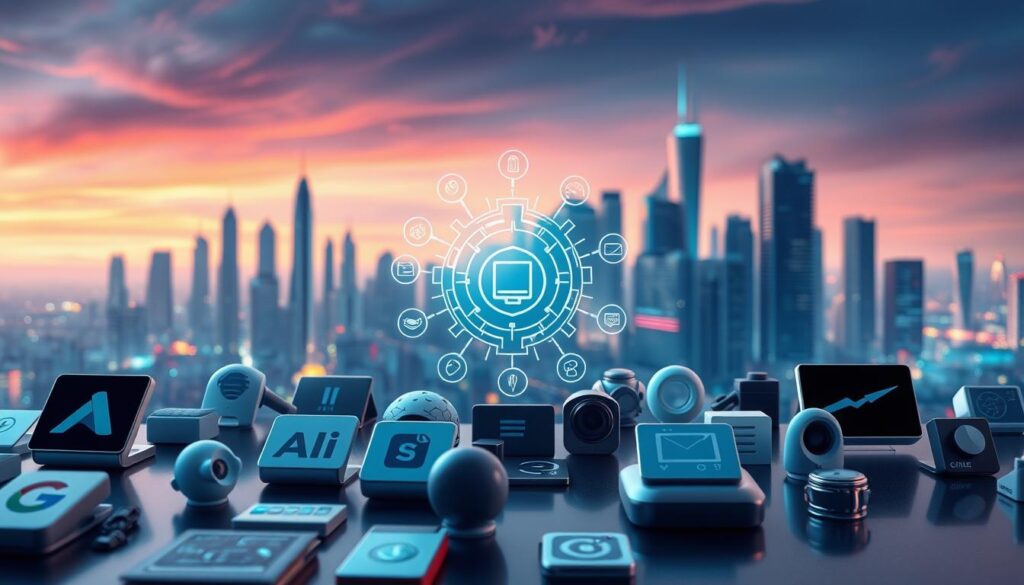
Today’s marketing automation platforms are changing how we talk to customers and analyze data. They use smart algorithms to make complex tasks easier and give us deep insights.
Workflow Optimization Platforms
Digital marketers have access to powerful tools that make their jobs easier:
- HubSpot: A full platform for getting leads and managing marketing
- Google Marketing Platform: It analyzes data and tracks campaigns
- Adobe Sensei: Uses predictive models for better content
Content Generation and Analytical Solutions
Natural language processing for sentiment analysis is a big deal. It helps us understand what customers really think. AI tools now offer amazing abilities:
- ChatGPT: Creates unique content and new marketing ideas
- Microsoft Copilot: Helps write marketing plans and creates content
- Jasper AI: Makes targeted content with data insights
These tools are more than just new tech—they’re key for marketers to keep up in the digital world. By using these AI solutions, businesses can work more efficiently and understand their customers better.
Predictive Analytics and Personalization: AI’s Superpower in Customer Engagement

Predictive analytics has changed digital marketing. It lets businesses understand and connect with customers in new ways. Thanks to advanced AI, companies can now predict customer behavior with great accuracy.
Personalized advertising algorithms are key. They analyze complex data to:
- Identify what customers might like
- Predict when they might buy
- Design marketing plans that hit the mark
Big names like Netflix and Amazon are experts at this. Their systems use lots of user data to offer experiences that feel made just for you. They look at what you watch, search for, and buy to suggest things that seem to know you.
Today’s predictive analytics does more than just suggest movies. AI tools can guess what customers need, manage stock better, and even spot when someone might leave. This helps marketers plan ahead, making customer interactions better.
Even small businesses can use these advanced tools now. Thanks to affordable AI, all companies can create smart marketing plans. This was once only for big tech companies.
Implementing AI in Your Marketing Strategy: A Practical Guide
Getting into AI-powered content generation can feel overwhelming for digital marketers. The secret to success is a careful, step-by-step plan. This plan should make your marketing better without stressing your team.
Starting Small: Your AI Integration Roadmap
Begin your AI adventure by tackling specific marketing problems. Making data-driven choices starts with focused efforts. Here are some first steps:
- Find a marketing task that can be automated
- Look for AI tools that fit that task
- Try the tool on a small project
- Check and review the results
Balancing Automation with Creative Genius
AI is great at handling data and routine tasks, but human creativity is still unmatched. The goal is to use AI to boost your team’s work, not replace it.
Marketing pros can stay ahead by learning new skills:
- Improve your strategic thinking
- Boost your creative problem-solving
- Grow your emotional intelligence
- Learn to use AI tools
Looking for help with AI marketing strategy? Crowley Media Group offers SEO, PPC, AI, and automation services. Visit crowleymediagroup.com or call (916) 572-9755 to start your AI marketing journey.
Navigating the Challenges: Ethics, Privacy, and the Future of Marketing Jobs
Digital marketers face big challenges when using machine learning for customer segmentation. AI’s fast growth brings both great chances and big ethical worries. These need careful handling.
Some main AI marketing challenges are:
- Data privacy and security risks
- Potential algorithmic bias
- Ethical issues in data collection
- Changes in marketing jobs
Using machine learning for customer segmentation needs clear data practices. Companies must focus on:
- Regular AI system checks
- Ensuring data is fair and diverse
- Keeping human oversight
- Setting clear accountability rules
The environmental impact of AI is also important. AI’s high energy use raises questions about sustainability. Using AI responsibly means looking at its tech and social effects together.
AI might change some marketing jobs, but it won’t replace human creativity. Skills like strategic thinking, building relationships, and solving complex problems are still unique to humans. They work well with AI.
Marketing pros should see AI as a partner, not a replacement. They need to keep learning and adapting to use machine learning for customer segmentation well and ethically.
Conclusion
The world of digital marketing is changing fast thanks to AI. Predictive analytics and smart automation are now key for businesses to stay ahead. Marketers who use AI will lead the way in innovation.
Using AI doesn’t mean losing human touch. It’s about making strategies better. The best marketing mixes tech insights with human ideas. This way, tools can make work easier, offer personalized experiences, and reveal new strategies.
Ready to see how AI can boost your marketing? Crowley Media Group is here to help. Our team combines the latest AI with marketing know-how to create plans that work.
Ready to evolve your marketing? Check out crowleymediagroup.com or call (916) 572-9755 for a chat. See how AI can change your marketing and move your business forward.