
Email marketing is still the top digital tool for businesses looking for real results. Unlike fast-changing social media trends, well-planned email campaigns keep delivering great returns. This is true when done with skill and attention to detail.
Today’s marketers know that email marketing is more than just sending messages. It’s about combining technical know-how, smart segmentation, and engaging content. This guide will show you how to turn your email strategies into powerful digital tools.
Learning about email best practices is not just about writing good content. It’s about building a complete system that respects users, uses the latest tech, and always adds value. By following the advice in this detailed guide, you’ll unlock email marketing’s full potential.
Key Takeaways
- Email marketing consistently outperforms other digital channels
- Technical foundation is crucial for successful campaigns
- Personalization drives higher engagement rates
- Compliance and consent are non-negotiable
- Continuous optimization is key to email marketing success
Build Your Foundation with Deliverability and Compliance
Successful email campaigns start with solid email deliverability. Without a strong technical base, even great content might not reach your audience. Think of email deliverability as the key that makes sure your messages get to where they’re meant to go.
The digital world has grown more complex. Email providers now have strict rules to keep spam out. Marketers must understand and follow these rules and standards.
Authenticate Your Domain with Key Protocols
Protecting your sender reputation is crucial. You need to use important authentication tools:
- SPF (Sender Policy Framework): Defines authorized sending IP addresses
- DKIM (DomainKeys Identified Mail): Provides cryptographic email signatures
- DMARC (Domain-based Message Authentication): Establishes alignment and protection policies
- BIMI (Brand Indicators for Message Identification): Displays verified brand logos in supported inboxes
Meet Modern Sender Requirements
Big email providers like Gmail and Yahoo have set new standards. They require:
- Mandatory domain authentication
- One-click unsubscribe mechanisms
- Spam complaint rates below 0.1%
Implement Intelligent List Management
Good email deliverability is about more than tech—it’s about respecting your subscribers. Keep your list clean by:
- Using explicit opt-in processes
- Implementing rolling “sunset” policies
- Removing unengaged subscribers systematically
- Monitoring sender reputation consistently
By focusing on these key areas, marketers can greatly boost their email campaigns’ success.
Grow a High-Quality, Permission-Based Email List
Starting a strong email marketing plan means having a list that really wants to hear from you. It’s better to have a few quality subscribers than many who don’t care. Your aim is to get people who actually want your content and offers.
To build a good email list, focus on giving value in exchange for sign-ups:
- Offer exclusive industry reports or insider insights
- Provide early access to new product launches
- Create interactive tools or personalized calculators
- Design members-only discount programs
Make your signup forms simple and clear. Only ask for the basics at first. Too many questions can scare people off. Use double opt-in to make sure people really want to join.
Use email validation to keep your list clean. Let subscribers choose what they want to see and how often. This makes them feel in control of their emails.
Good email marketing isn’t about having a huge list. It’s about connecting with people who value what you send.
Master Email Marketing Through Smart Segmentation and Personalization
Email marketing has changed a lot. Today, it’s all about connecting with people through smart segmentation and personalization.
Now, email marketing is more than just sending out emails to everyone. It’s about using many data points to make real connections. This means looking at more than just who someone is.
- Behavioral data tracking website interactions
- Lifecycle stage understanding
- Firmographic insights for B2B communications
Leverage Powerful Segmentation Strategies
Personalizing emails starts with knowing your audience’s journey. By looking at how customers behave, you can make emails that really talk to them.
- Track purchase history for precise targeting
- Monitor content consumption patterns
- Identify customer lifecycle stages
Implement Dynamic Content and AI Recommendations
AI tools help make emails super personal. With dynamic content, emails can change based on who’s reading them. This makes people more likely to engage and buy.
Studies show segmented emails can make up to 760% more money than regular ones. By treating each person as unique, brands can build stronger connections.
The goal is to use technology to understand what customers really want. Smart email segmentation is about sending the right message at the right time. It’s not about overwhelming people.
Craft Email Copy That Captures Attention and Drives Action

Creating compelling email campaigns needs a strategic approach. You must write in a way that grabs attention and motivates readers. Your success depends on crafting messages that meet your audience’s needs and desires.
Start with a subject line that stands out. Keep it short and impactful, usually under 50 characters. Your goal is to spark curiosity and offer clear value.
- Use power words that evoke emotion
- Personalize with recipient’s name or specific interests
- Create a sense of urgency without being pushy
When writing the email body, focus on these key principles:
- Write in a conversational tone
- Keep paragraphs short and scannable
- Highlight benefits, not just features
The call-to-action (CTA) is crucial. Make it:
- Visually prominent
- Directly aligned with your primary goal
- Clear and compelling
Mobile optimization is essential in today’s email marketing. Design for thumbs with large, tappable buttons and readable fonts. Ensure your message looks great on any device.
Great email marketing is about connecting, not just selling. Speak to your readers like a trusted friend. Understand their challenges and offer genuine solutions.
Automate Lifecycle Journeys for Maximum ROI
Email automation turns marketing into a strategic system that keeps bringing in money. It uses smart, data-driven workflows to give customers tailored experiences. This boosts email ROI a lot.
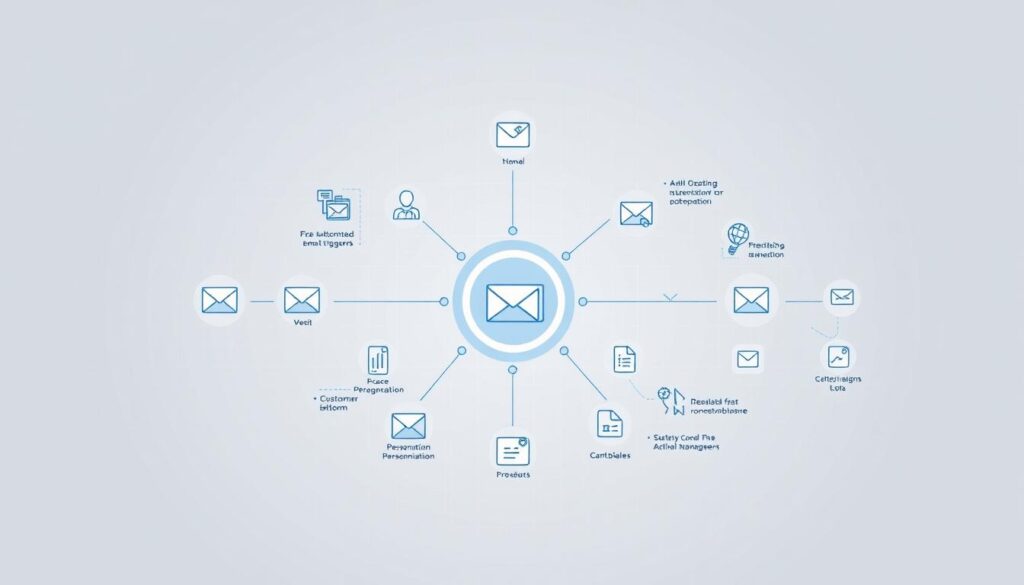
Good email automation needs well-thought-out lifecycle journeys. These engage customers at the right time. Let’s look at the main automated flows every business should have:
- Welcome Series: Set expectations and deliver immediate value to new subscribers
- Onboarding Sequences: Guide new customers through activation milestones
- Abandonment Flows: Recover potential lost sales with gentle reminders
- Post-Purchase Campaigns: Educate customers and encourage additional purchases
- Win-Back Campaigns: Re-engage lapsed customers with fresh incentives
Build Core Flows That Convert at Every Stage
Good email automation needs smart segmentation. For B2B, use lead scoring with firmographic and behavioral data. Start nurture sequences when customers are in different buying stages.
Coordinate Omnichannel Triggers Across Platforms
Today’s email automation goes beyond just email. It connects experiences across email, SMS, push notifications, and direct mail. Each channel has its own role: email for depth, SMS for urgent alerts, and push for app interactions.
Remember, email automation is not about replacing human touch. It’s about scaling personal experiences that would be too hard to do by hand.
Optimize Your Send Strategy and Measure What Matters
Email analytics are like a compass for successful marketing. Great email campaigns rely on data, not guesses. Knowing how to measure and improve your email can change your marketing game.
To get better at email marketing, focus on these key strategies:
- Match email frequency to subscriber value, not calendar constraints
- Leverage send-time optimization tools
- Implement smart segmentation techniques
- Track meaningful metrics beyond vanity stats
Deeper into email analytics means looking at more than just numbers. Old metrics like open rates aren’t as useful anymore. Instead, focus on:
- Click-through rates
- Conversion rates
- Revenue per recipient
- List health indicators
Testing is key to email best practices. Try different things, like subject lines or buttons, one at a time. Use big enough samples and check results often to avoid false positives.
Your goal is to make an email strategy that keeps getting better. By using data to improve, you’ll make emails that really connect with people.
Conclusion
Successful email marketing is more than just tactics. It’s a mix of technical skills, creative storytelling, and knowing your audience well. Marketers who succeed in 2025 focus on building trust, delivering relevant content, and treating subscribers right.
The future of email marketing needs a complete approach. This includes using authentic data, smart segmentation, and automation. AI helps by making messages more personal, but it’s the human touch that truly connects with people.
Your email marketing plan should solve problems and offer real value. Every email should answer the question: “What’s in it for me?” By creating content that meets specific needs, you can turn email into a powerful tool for growth.
If you want to improve your email marketing, getting professional help can help a lot. Crowley Media Group offers expert advice in creating effective email systems. Visit crowleymediagroup.com or call (916) 572-9755 to boost your email marketing and increase your ROI.